


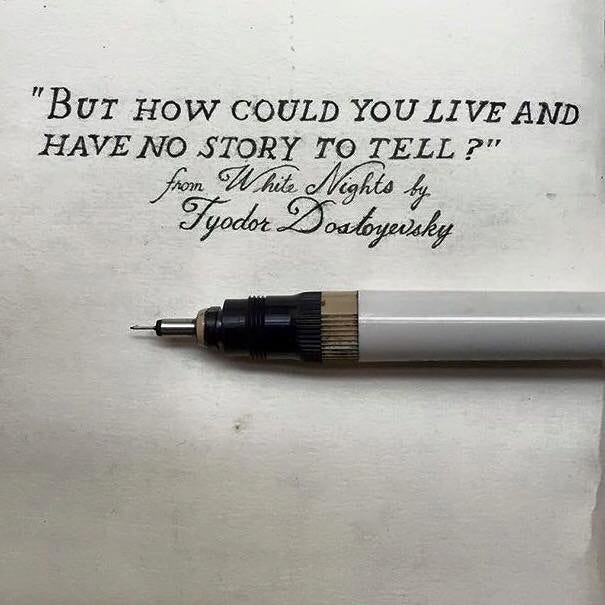
I recently finished White Nights by Dostoevsky and was left speechless once again as to how universal the human experience really is, and in awe at how some people capture its timelessness perfectly.
The story follows a young man, the Dreamer, who falls in love with a lady who says from the very beginning that she is not interested in him as anything more than a purely platonic friend. Despite this, he continues yearning for her, thinking entirely about her, trapped in his limerence.
The story starts the way you might expect a love story to start, with the two of them meeting serendipitously. The Dreamer is walking by the water on his daily walk, passing by a man that he sees every day and almost says hi to. He then sees a beautiful young woman, Nastenka, who appears to be crying. In archetypal fashion, he comes in to save her, to dry her tears, but she appears threatened and starts walking away quickly. Another man begins following her, and so the Dreamer quickly catches up to Nastenka to deter the other man.
The two of them form a close friendship, with Nastenka adamantly telling our main character that they are *just* friends, and with typical male audacity, he does not respect her wishes and continues to meet her daily, hoping that she will fall in love with him. Their friendship blossoms, and Nastenka vents to the narrator, telling him about how she has been waiting for another man for over a year, but she fears he may not come because it has been so long.
The story proceeds, leading us as the readers to believe that she will change her mind and end up with the narrator, but alas, the man she was waiting for shows up and sweeps her away.
Nastenka sends the narrator a letter saying how she wished she could have loved them both, and the story ends with the narrator letting life continue to happen around him, always in some state of idealising the future, missing out on what could have been a beautiful, fulfilling friendship because he could not accept that Nastenka was a person with her own wants and desires.
Both the Dreamer and Nastenka are very isolated, albeit for different reasons, but their friendship clearly filled a need that they both had. There is a fundamental difference between their stories: Nastenka’s circumstances, which were driving her isolation, change when she marries the man, but the Dreamer stays stuck. He romanticises women from afar, and even when they are close, he refuses to listen and see them as they are, instead just focused on his own wants and needs.
We are currently in an era where everyone is convinced that there is something wrong with themselves, and that they are a project to be improved infinitely. Somehow, incel culture has infiltrated its decaying tendrils into podcasts, social media, and everyday life. As technology has blended and enmeshed itself deeper into our society, we have opened ourselves up to new kinds of negative influences.
Of course, it is not bad to want to improve and be better, the issue is the original premise, which is that we are somehow undesirable at baseline, and so we maxx. Some have taken the unrelenting tide and turned it into a more positive idea, such as whimsymaxxing, but the majority of our self-optimisation culture is still linked to low perceived self-worth, amplified by social media.
Maxxing culture creates an environment which drives us to become more self-absorbed, fixating on ourselves, ruminating on our insecurities, and ultimately driving us further into loneliness.
The Dreamer is obsessed with who he could be to Nastenka; he loves the idea of being in love, and he enjoys the idea of being chosen. Everything is actually about him.
In online spaces, people (at first mainly men) began positioning masculinity as something based on superficial ideas, like looks and money, and with it grew their feelings of entitlement, which at some point we started calling the male loneliness epidemic.
Dostoyevsky teaches us that as long as your primary focus is on yourself, you can never step out of your own way to allow for connection, and as such will remain stuck in your isolation and loneliness.
The Dreamer, ironically, cannot see outside of himself long enough to see what Nastenka was providing, what he needed so deeply - connection - because he cannot accept the gift in the form in which it is offered.
To conclude, Dostoyevsky is the GOAT. Let’s all get out of our own heads and start living a little!
What strikes me is that many industries benefit when people feel incomplete. If you're convinced you're not attractive enough, successful enough, wealthy enough, or fulfilled enough, you'll keep buying, scrolling, and searching for the next thing that promises satisfaction. The pursuit never ends because the dissatisfaction is part of the business model.
The irony is that a culture obsessed with self-fulfillment often leaves people feeling more isolated, while a faith centered on self-giving was designed to bind people together.
Love this perspective in the context of the male loneliness epidemic! When I read White Nights I only felt sympathetic for the Dreamer, like it was the 19th century version of a devastating 2010’s-esque situationship. Interesting to see how the meaning shifts if you resonate more with his or Nastenka’s position